Log #8: São Miguel Ashore, a Short Jump to Horta, and Reading the Weather West
Ponta Delgada and Horta, the Azores
A quick note on format: for this next leg — the long crossing to Bermuda — I'll be posting all the updates in this single thread rather than starting a fresh post each time. Follow along here and you'll have the whole passage in one place.
Six days at sea earns you a few days on land, and São Miguel delivered — hot springs, waterfalls, a 140-year-old tea factory, pineapples grown under glass, and a caldera that changes its mind in thirty minutes. Then a quick overnight hop put us in Horta, where we watched the weather, weighed the trade, and this morning slipped the lines for the long jump to Bermuda.
We were met in Ponta Delgada by some of the warmest, most genuinely welcoming people of the whole trip — the kind of reception that makes a tired crew feel human again. We took one full down day to do the unglamorous work: scrub the boat, put everything back where it belongs, shoot some photos for interested buyers, and generally recover from six days of the ocean moving the floor around. There's a particular kind of tired that only a passage produces, and the cure is a day of not going anywhere.
Then we rented a car for two days and packed the sights in tight.
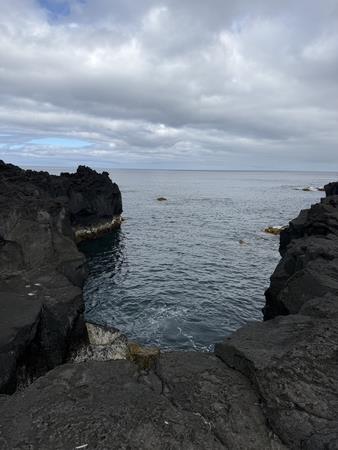
Hot springs. We hit two, and my clear favorite was Ponta da Ferraria — a geothermal spring that flows straight into the sea. You sit in a natural pool where scalding volcanic water mixes with the cold Atlantic, and the temperature rises and falls with the surge as each swell pushes in and draws back. Hot seawater with a gentle ocean rhythm doing the mixing for you; I've been in a lot of hot springs and never one quite like that.
Waterfalls. The island is green in a way that only a lot of rain explains, and that rain has to go somewhere. We chased a few of the falls that come with the territory.
Gorreana Tea Factory. This one got the engineer in me going. Gorreana has been making tea on this hillside since 1883 — the oldest tea plantation in Europe, and one of the last still running. We walked the fields and then the line, watching a process that has barely changed in 140 years, right down to hand-sorting the leaves as a final quality-control step. Machinery where machinery earns its keep, human eyes where they still beat the machine.
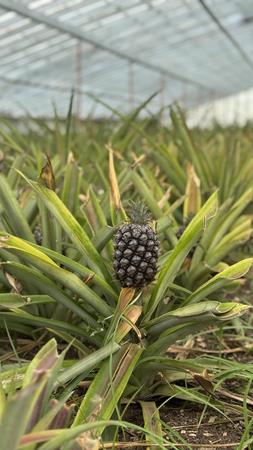
A pineapple plantation. I did not expect pineapples in the middle of the North Atlantic, but São Miguel has been growing them under glass since the mid-1800s — when the island's orange trade collapsed and growers needed a new crop. These aren't field pineapples. They're raised in whitewashed glasshouses that recreate a tropical climate the Azores don't naturally have, and the plants take roughly two years to bear a single fruit. There's even a deliberate "smoking" step, where the greenhouses are filled with smoke to trigger every plant to flower at once for a uniform harvest. The result is a smaller, denser, more complex fruit — enough of a specialty that it carries a European Protected Designation of Origin. Two years and a smokehouse for one pineapple; you taste it differently after that.
Furnas. Lunch here is a piece of engineering in its own right. In the geothermal field, restaurants bury their cozido das Furnas — a layered meat-and-vegetable stew — in the volcanically heated ground and let the earth cook it for hours. We watched a few pots get hauled up out of the steaming holes, then sat down to eat the batch that had come out of the ground that morning. Slow food in the most literal sense: the planet is the oven, and it runs on its own schedule.
Sete Cidades. The showstopper, and a lesson in Azorean weather all by itself. We arrived to brilliant sun over the twin crater lakes, and within about thirty minutes watched cloud pour over the caldera rim and down the inside walls at a genuinely startling pace — a waterfall made of fog. Then we drove out to the west and, minutes later, were back in full sun. If you want to understand why we obsess over weather windows out here, spend half an hour at Sete Cidades.
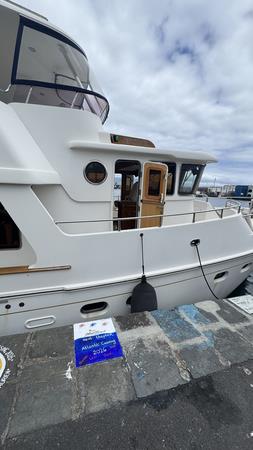
The short hop to Horta. Thursday we slipped the dock at noon and ran 21 hours direct to Horta — an easy overnight after what came before. Once again the marina gods smiled on us: the harbormaster told us they'd been completely full until two days prior. Our timing was pure luck, and it's holding for a reason — the ARC boats are starting to leave the islands for the mainland in sizable flotillas, and space is opening up behind them just as we arrive.
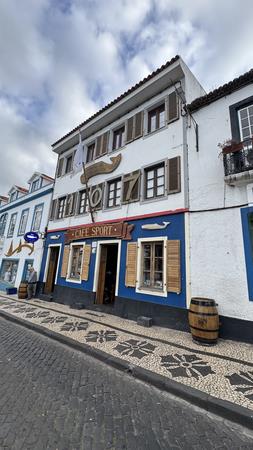
Two things you don't skip in Horta. There's a pair of rituals every crew that stops here is honor-bound to observe, and we did both. The first is Peter Café Sport — the legendary sailors' bar that has been the crossroads of the mid-Atlantic since 1918, where generations of crews have checked in, swapped weather notes, and steadied their nerves before the jump. We paid our respects and, per tradition, drank the gin. The second is the mural. Horta's long breakwater is covered end to end in thousands of paintings, each one left by a passing boat — superstition holds that if you don't paint your mark before you leave, the sea will take offense. We were not about to test that theory on the eve of a two-week crossing, so we found a bare patch of concrete and left Next Chapter's mark alongside the rest.
The one open item. We'd hoped to take delivery of a part here — a failed Maretron pressure sensor from one of our fuel tanks — but it was stuck somewhere in the shipping pipeline on the mainland. We ordered it within hours of catching the failure on the leg from the Algarve to São Miguel, and were assured it would be waiting for us. It was not. Worth being precise about what this actually means, because it drove the next decision: the sensor is a nice-to-have, not a critical component. We still have manual sight gauges on both tanks and a working digital gauge on the starboard tank. Losing the port sensor makes fuel monitoring less convenient, not less safe — and on a crossing, that distinction is the whole game.
Now the big one. Our sights were set on the long passage to St. George's, Bermuda — 14 to 16 days of open water. We watched the weather closely, and specifically how far north the Azores High decided to push, because that high is both our obstacle and our friend: a sailor curses its dead air, but a trawler wants exactly that flat water, and riding its northern edge is how we make the miles with margin while also staying south of the lows. The forecast opened a departure window starting on Saturday that may hold through Monday, and Sunday landed right in the sweet spot. Giving us enough time to rest and partake in Horta traditions. That set up the trade we weighed at the dock: a great weather window now, versus waiting on a tank sensor we'd already established we don't strictly need. Weather doesn't negotiate and parts do, and when a proven boat, a sound forecast, and a redundant system all line up, you don't hold a good window hostage to a convenience. So we made the call — we cast off Horta at 10:45 this morning, local time, without waiting on the part, and pointed the bow west.
More to come now that we're underway.
Watch the dot: trackmywake.com/wake/next-chapter.
— Chris & the crew of Next Chapter